20 Things Your Map Won’t Tell You About New York
Wander’s home city is full of surprises that never make the usual trivia lists. Here are twenty of them — odd, true, and still hiding in plain sight.
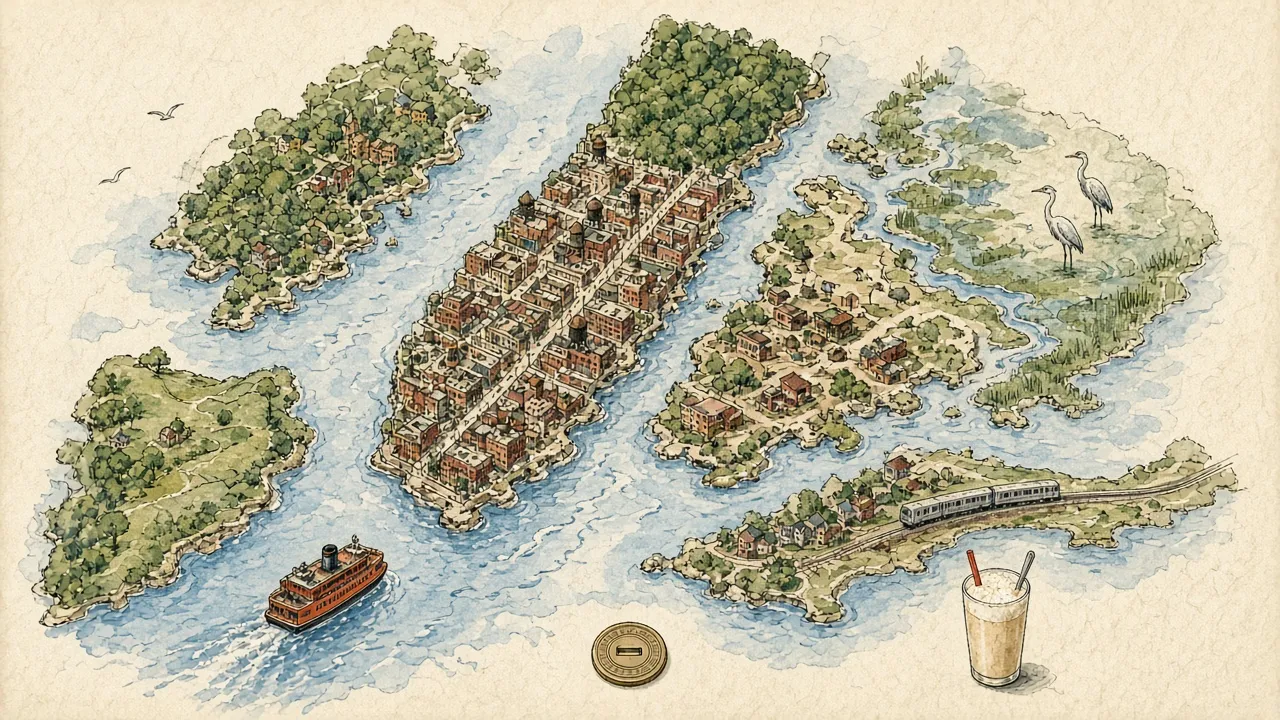
- Four of the five boroughs are islands. Manhattan and Staten Island are islands of their own; Brooklyn and Queens sit on Long Island. The Bronx is the only borough attached to the North American mainland — which is why New York is, at heart, a coastal archipelago pretending to be a single city.
- A piece of Manhattan is not on the island of Manhattan. Marble Hill is legally part of the borough of Manhattan, but it sits on the mainland, on the Bronx side of the water, with a Bronx ZIP code. A late-nineteenth-century shipping canal cut it off from the island; landfill later joined it to the Bronx. The paperwork never moved.
- Brooklyn was once the fourth-largest city in the United States. The 1890 census put it behind only New York, Chicago, and Philadelphia. On January 1, 1898, it joined the new five-borough city after a referendum so close the official tally was 64,744 to 64,467. Brooklynites still argue, in the friendliest possible way, about whether that was a good idea.
- The Staten Island Ferry is free, and it never really sleeps. The city has run the route since 1905. Today it still crosses the harbor 24 hours a day, every day of the year, between St. George and Lower Manhattan — no fare, and more than 16 million passengers a year.
- The city’s next great park used to be a landfill. Freshkills, on Staten Island, was once called the world’s largest dump. It is being turned into a 2,200-acre park, opening in phases, that will be almost three times the size of Central Park.
- Central Park is not New York’s largest park. That title belongs to Pelham Bay Park in the Bronx, which is more than three times as big. The Greenbelt on Staten Island comes in second. Manhattan’s famous rectangle is, officially, fifth.
- New York City has only one freshwater river, and it is in the Bronx. The Bronx River — named for Jonas Bronck, a settler who arrived in 1639 — was later treated as an open sewer, stacked with tires and old appliances. After decades of cleanup, fish and herons have found their way back.
- Manhattan still has a last patch of wild forest. Inwood Hill Park, at the island’s northern tip, contains the last natural forest and salt marsh left in Manhattan — a reminder that the borough was not always a grid of streets.
- One of the Northeast’s largest bird habitats is inside the city limits. Jamaica Bay Wildlife Refuge, mostly in Queens, covers more than 12,600 acres of water, marsh, and islands. It was created in the 1950s and became part of a national park in 1972. Migrating birds have been using the bay a lot longer than the subway has.
- The subway really does run all night. It is the largest and busiest system in North America: 472 stations on 25 routes. It opened in 1904 with just 28 stations, and it still operates 24 hours a day, 365 days a year — even if a weekend sometimes means a shuttle bus and a sense of humor.
- You can ride more than 31 miles without changing trains. The A train’s run from 207th Street in Manhattan to Far Rockaway in Queens is the system’s longest one-seat ride. The longest gap between stations is also on the A, out in Queens: 3.5 miles between Howard Beach/JFK and Broad Channel.
- The little metal token had a good fifty-year run. Tokens arrived in 1953, when the fare rose to 15 cents, and were retired in 2003 in favor of the MetroCard. As of January 1, 2026, you can no longer buy or refill a MetroCard either. The turnstile has moved on again, this time to a tap.
- The city’s first subway station is still down there. The original City Hall station, opened with the system in 1904, was a civic showpiece of tile vaults and skylights. It was taken out of passenger service in 1945, but it was never fully abandoned: the downtown 6 still loops through it to turn around.
- For 91 years, New York legally treated dancing as a special occasion. A 1926 cabaret law required many establishments to get a license before they could let patrons dance. Critics have long noted that early enforcement targeted interracial crowds in jazz clubs. The City Council repealed the licensing requirement in 2017. Zoning and fire rules still apply; the old permission slip does not.
- A classic New York egg cream contains neither egg nor cream. It is milk, seltzer, and chocolate syrup, mixed in that slightly ceremonial way that soda fountains used to make look easy. How it got the name is a cheerful muddle. What’s in the glass is not.
- The Waldorf salad began as three ingredients and a hotel opening. In 1893, Oscar Tschirky, the maître d’hôtel at the original Waldorf, is credited with a simple mix of apples, celery, and mayonnaise. Walnuts, the ingredient most people now expect, were a later addition. The name traveled much farther than the dining room.
- In the West Village, West Fourth Street crosses West Tenth, Eleventh, and Twelfth. The Village’s streets were laid out before the 1811 Commissioners’ Plan imposed Manhattan’s numbered grid, and the old pattern was left in place. Later, older street names were swapped for numbers that were never meant to meet. The crossings are still on the map.
- Broadway was not part of the 1811 street plan. It was salvaged from older roads, including the Bloomingdale Road, and only later stitched back into the grid. The famous diagonal is what gives Manhattan its “bowties” — those odd triangular intersections where the old road cuts across the new avenues.
- Most of New York's tap water is never filtered. It comes from a vast upstate watershed of 19 reservoirs and three lakes, as far as 125 miles north of the city. In 2025 the Catskill and Delaware systems supplied more than 90 percent of it, and because that supply is protected at the source, New York is one of only five large U.S. cities that does not filter its surface drinking water. Gravity does much of the work — the pressure is enough to reach about the sixth floor of most buildings, which is why so many taller ones still wear those wooden rooftop tanks.
- New York’s landmarks law exists because the city tore down a masterpiece and immediately regretted it. The original Pennsylvania Station, a McKim, Mead & White palazzo completed in 1911, was demolished in 1963. In 1965 the city created the Landmarks Preservation Commission. Today it protects more than 38,000 properties, in historic districts across all five boroughs.
Every fact here was checked against official city, state and museum sources, including NYC Parks, the MTA, the NYC Landmarks Preservation Commission and the New York Transit Museum.